A hand wash station is the right call when hands touch food, or when hands get dirty enough that sanitizer gel does nothing useful. Festival and market vendors working the Old Fourth Ward stretch near the Atlanta…
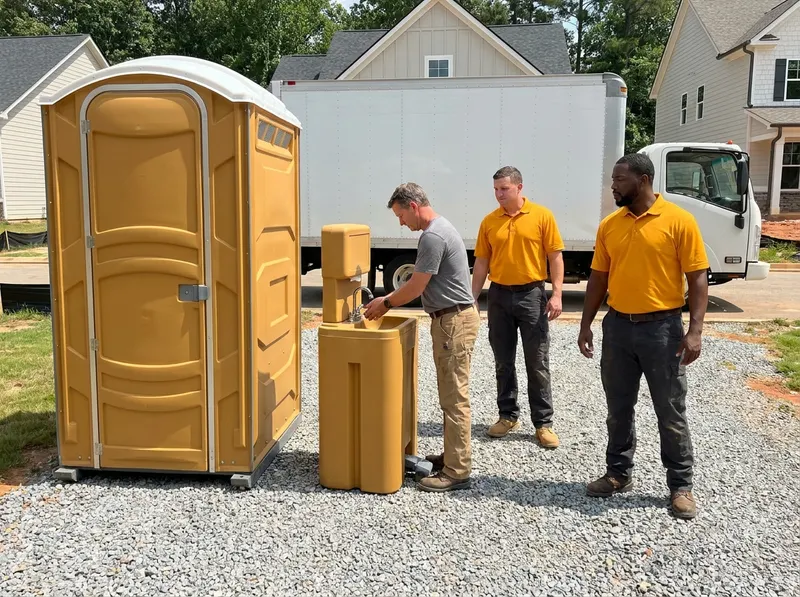
A hand wash station is the right call when hands touch food, or when hands get dirty enough that sanitizer gel does nothing useful. Festival and market vendors working the Old Fourth Ward stretch near the Atlanta BeltLine Eastside Trail, catering crews staging behind Chastain Park Amphitheatre, and taco and coffee trailers parked for block parties in Kirkwood and Cabbagetown all get asked the same question by a reviewer or a client: where do the vendors wash. A two-station sink answers it with running water, soap and towels in one place. Hand sanitizer stands are a supplement, not a substitute, when food handling is involved. Confirm the specific requirement with the reviewing county health office — Fulton County for most of the city, DeKalb County for the eastern neighborhoods including Kirkwood and parts of Reynoldstown — before you finalize the count.
The alternative worth weighing is a restroom trailer, which has sinks plumbed inside. A trailer makes sense for weddings in Buckhead or Collier Hills backyards and for film base camps where guests and talent expect an interior room with mirrors and hot water. It also needs a level pad, tow access, and often a generator. A stand-alone hand wash station needs nothing but a firm, level spot and a hand truck path. That is why sinks win on tight sites: a rowhouse infill lot in Adair Park, a fenced pad off a narrow West End side street, a Grant Park gathering where the nearest vehicle access is a curb lane and everything else moves by cart. The trade-off is honest — no hot water, no enclosure, and a finite tank.
Tank capacity is the number that decides your quantity. Typical two-station portable sinks in this market carry roughly 15 to 25 gallons of fresh water, and Georgia summers accelerate every gallon of it. In July and August a sink parked in open sun near Piedmont Park or Centennial Olympic Park gets used more, gets used longer, and runs dry faster than the same unit in October. Plan one hand wash station for every two to four portable restrooms, and add a unit rather than betting on a mid-event refill during Atlanta traffic. For multi-day festivals we schedule refills and gray water pump-outs at set times so vendors know when service arrives instead of guessing.
Placement is where jobs go wrong. Sinks belong on the vendor or crew side of the layout — shaded if possible, on pavement or compacted ground, downhill from nothing, and clear of the exit path where a queue would block traffic. Gray water is not clean water and does not go into a storm drain, a Freedom Park tree lawn, or a hillside near the Grant Park and Zoo Atlanta entrance; we haul it out. We run our own trucks and inventory, so the person who quotes your Atlanta job is the person routing the delivery. Tell us the gate code, the drop point, and any hours restriction, and it gets loaded into the route note.
Pricing below is a ballpark for planning. Exact pricing is confirmed on a free on-site visit or a short call about access, dates and service frequency, and it holds for the term quoted.
Every job gets a firm, written price after a free on-site visit.
Tell us about your portable hand wash station rental job in Atlanta and we'll send a clear, written quote — usually the same day.
 Power Mobile Restroom Solutions