A standard unit is the right call when the job needs a working restroom, not a showpiece. Framing crews, roofers, grading contractors, utility crews, church workdays, neighborhood cleanups, and film base camps in…
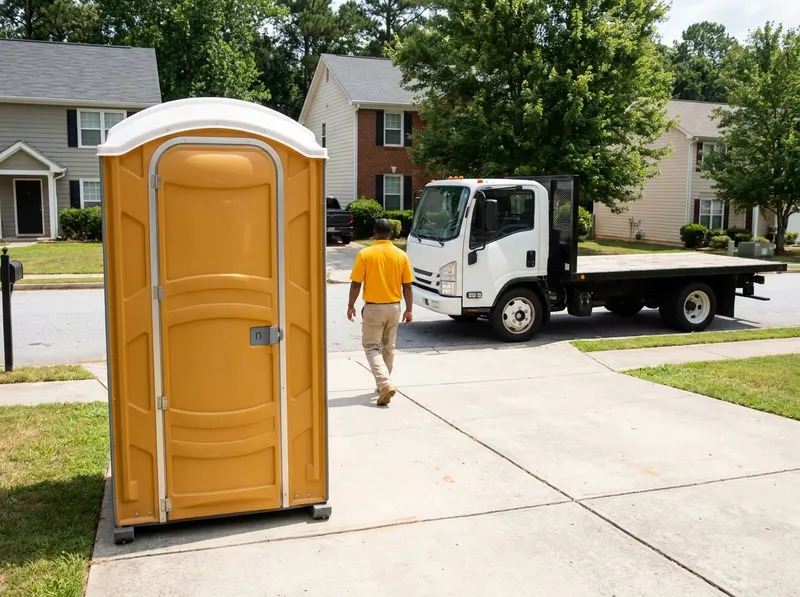
A standard unit is the right call when the job needs a working restroom, not a showpiece. Framing crews, roofers, grading contractors, utility crews, church workdays, neighborhood cleanups, and film base camps in Atlanta all run on standard units because they are narrow enough to fit a driveway or a strip of right-of-way, light enough to move by hand once empty, and priced for long stays. The trade-off is honest: a standard unit has no sink inside, no flush, and no climate control. If the guest list is dressed up, or the site needs a wheelchair-accessible stall, or the crew must wash before handling food, a standard unit is the wrong tool and we will tell you that on the phone instead of after delivery.
Placement drives more Atlanta service problems than the unit itself. In Cabbagetown, Reynoldstown, and Kirkwood, the buildable lots are tight and the service truck often has to work from an alley or a one-lane street, so we need the drop point within reach of a hose run rather than tucked behind a fenced back yard. Grant Park and Adair Park infill builds usually mean a historic-district block with parked cars end to end — we ask where the unit can sit without blocking a sidewalk. Buckhead and Collier Hills driveways come with low tree limbs and gate codes; a truck that cannot get under the canopy cannot service the unit, so those details belong in the order, not in a surprise. Old Fourth Ward and West End projects near the BeltLine Eastside Trail and heavy foot traffic often need the door faced away from the path and the unit staked or strapped on exposed pads. We serve Fulton County and the eastern DeKalb County side of the city, and traffic is planned into the route, not used as an excuse.
Georgia summer is the reason service frequency matters more than the sticker price. Heat and humidity accelerate odor in any holding tank, so standard units on active sites are scheduled weekly by default, and high-use sites can be set to twice weekly. Every service visit includes a tank pump-out, an interior rinse, fresh deodorizer, and a paper restock. Units placed in full afternoon sun in West End or on an open Virginia-Highland lot do better with a shaded or east-facing spot when the site allows one. If a unit tips in a storm, gets vandalized, or the crew count jumps mid-project, call dispatch and we adjust the plan — extra visits and relocations are priced, not improvised.
Quantity is arithmetic, not guesswork. A common construction planning figure is one standard unit per 10 workers on a 40-hour week with weekly service; for a short event, one unit per roughly 50 guests over a few hours is a workable starting point, adjusted up when alcohol is served or the day runs long. Tell us the headcount and the hours and we will size the order out loud so you are not paying for a unit you do not need or short one at 7 a.m. on inspection day. We are a supplier with our own units and service route — the person who quotes your job is working from real inventory and a real schedule. All figures below are ballparks; the exact price is confirmed on a free on-site visit.
Every job gets a firm, written price after a free on-site visit.
Tell us about your standard portable toilet rental job in Atlanta and we'll send a clear, written quote — usually the same day.
 Power Mobile Restroom Solutions